Anti-feminism in the Kitchen

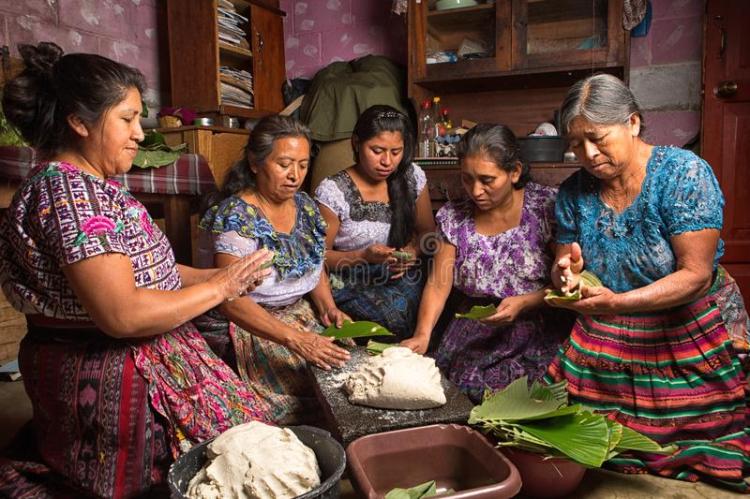
Mrs. Beeton’s The Book of Household Management, “As with the commander of an army, or the leader of any enterprise, so is it with the mistress of a house.” Men are not designed to work in the kitchen– they are designed to hold office and be the source of income for their wives and children. Therefore, women are subjected to be in the kitchen, and by doing so they are all subjected to the bias and stereotypes that are attached to their gender. In Mexico these roles are no different; since ancient times women been the core of feeding their communities, harvesting corn, grinding masa, and making tortillas. But women being then and now is not easy– after reading Jeffery M. Pilcher’s Planet Taco, I observed the numerous instances where points out misogynistic behaviors towards women. For example, Pilcher writes about a German man, Carl Sartorius, observing women as they cooked, “in which rows of brown women, the upper part of the body quite naked, or but indifferently covered, kneel on the floor, and crush maize on flat stones…” (92). Here the tone of this observation is demeaning and ill-written. He focuses on their bodies, saying that the “upper part of the body quite naked”, alluding to his disgust with their appearances. In addition, the entirety of the observation seems as if it was meant to dehumanize the women and their work. This relates especially to the Tamale Queens’ reputation amongst the public: “The chili queens thus helped create a stereotype of dusky, sharp-witted women, waiting to be tamed by Anglo men” (110). It is unfortunate that the role these women are subjected to is bound to lead to the hypertextualization. There is always this looming notion that the way a woman dresses or her body language yields to her being labeled as untamed or uncontrolled. During the time of the Chili Queens, a lot of racism and anti-feminism was used to castrate Mexican women and that they are unsuitable to obtain respect. Further, for the mere fact that the Chili Queens are responsible for cooking and running the stands, it puts them in a category where white men feel it appropriate to condescend them. The idea of Mexican women “waiting to be tamed by Angle men” coincides with the notion of modernizing and forcing assimilation upon Mexicans– pulling them away from their traditions and customs. It also implies that if a Mexican woman is beautiful and selling tamales, that she needs to be tamed because that type of work is below her.
Lastly, even though a women’s place in the kitchen can be hypersexualized and looked down upon, there some stories that provide rich and uplifting support for the tradition. Women like Encarnacion Pinedo published a cookbook to preserve the traditions of Mexican cuisine. It evident that her fuel to make the cookbook stemmed from her disapproval of typical American food, “there is not a single Englishman who can cook, as their food and style of seasoning are the most insipid and tasteless that one can imagine” (102). This attitude is one that many women and men had toward American food. That is why so many Mexican and immigrants in general, have committed themselves to share their flavors and cuisines with Americans. This only prompted people and restaurants to realize that their recipes need to change for the better. But most all, it safe to say that without women in the kitchen many of the famous flavors we know today wouldn’t be available. Therefore, it is imperative to acknowledge the millions of women who have run kitchens that have been categorized and discriminated against because of their gender, status, and color.

Work Cited:

Pilcher, Jeffrey M. Planet Taco: a Global History of Mexican Food. Oxford University Press, 2017. p. 92,102, 110.

Beeton, Isabella. The Book of Household Management. Benediction Press, 2010.
Seeds Grow in New Places Too

Ever since I was 14 (the age I believe my taste buds matured), I have insisted that on my birthday we dine at a Mexican restaurant. The first notable restaurant I remember visiting was El Mariachi, in Rockville Center. The inside was adobe style, with curved thresholds; walls decorated with Mayan calendars and serape blankets. The food was amazing and that is where I fell in love with enchiladas. The second restaurant in the city is El Cantanero, located in the West Village. This restaurant was similar to El Mariachi, but this time, it has two levels, with the second being a full-fledged club. I can say with confidence that El Cantanero has some of the best chimichangas I’ve ever. I know this sounds like a restaurant review, but it’s not– this is an acknowledgment of two Mexican restaurants out of thousands that have established themselves in New York City and Long Island. And thinking deeply about how Mexican foodways, I now realize how much people enjoy it. But we wouldn’t be able to experience Mexican food if people didn’t immigrate and set up restaurants that share the food with a new country and community.  In Jeffery M. Picher’s Planet Taco, he mentions the success of Mexican chefs, “[y]et, even with a growing Mexican national homogenization, chefs remain proud of their hometowns and will gladly explain their local culinary twists. Indigenous population offers the most distinctive cuisines…” (208). The restaurants described above are the product of immigrants whose mission is to share not only the generic cuisines of Mexico but also the cuisines of the indigenous states of Mexico. The idea of explaining the specifics of a dish with a customer at a restaurant is how the people of the new country (the United States) learn about what makes Mexican food special. For example, a customer asks about the “green sauce” on a tostada, and the waiter replies the main ingredient are poblano peppers. That leads the customer not only to wonder what poblano peppers are but also allows them to realize that the taste associated with the green sauce can only be attributed to the poblano pepper because it is truly unique. I think having a Mexican restaurant in the United States, especially New York City, chefs forced to put their twists on dishes because the standard ingredients are not available. And these twists are just as prevalent as eating the “real thing” in Mexico because it continues to attract people new to Mexican food but also those who crave to feel closer to home. The presence of fellow Mexicans in a restaurant is what signifies the owners and the people that work there that what they do means something. Maybe that time when I celebrated my birthday at El Cantanero, somewhere else in the restaurant someone was celebrating finding a restaurant that made food closest the way they know it to taste. Further, having the presence of various indigenous foods creates a multiverse of ways to experience Mexico two thousand miles away. 

Works Cited:

Pilcher, Jeffrey M. Planet Taco: a Global History of Mexican Food. Oxford University Press, 2017.

Mexican Food Explained

Gustavo Arellano’s Taco USA was a great way to familiarize yourself with Mexican food literature and history. He brings a proactive and vivid account of the impact of Mexican food on American Culture. With a journalistic background, Arellano’s inherent persuasiveness allow the reader to develop a respect for the pioneers of Mexican food. In other words, those who inadvertently remained in America after the Mexican-American War. The explosion of Mexican food in the west leads to American putting their own twist on the food, and eventually capitalization. Arellano also uncovers what the American people do not know, like the process of nixtamalization, and how Taco Bell got its false start. Most importantly, he reveals the long and grueling competition amongst “Mexican food chefs” in the United States­­ and stories of some Mexicans who were able to enter the competition. Arellano’s goal is to illuminate how much America’s food culture depends on the foodways brought from Mexico.

Wrong Title, Negative Effect

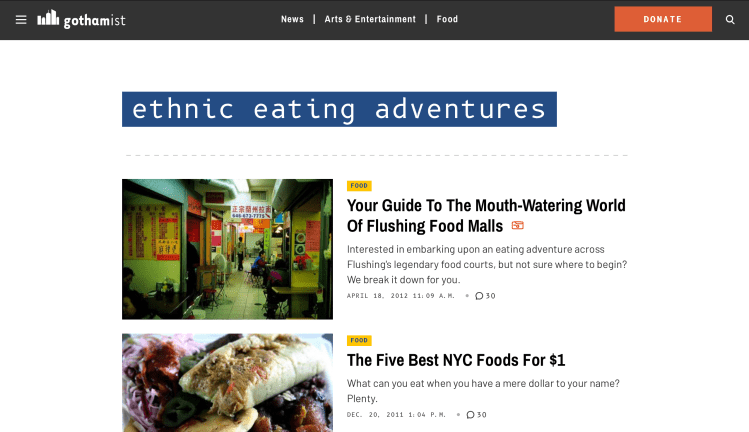
Screenshot of Gothamist’s “Ethnic Eating Adventures” page.

So, I was researching, look for articles on Taqueria Coatzingo, and I stumbled upon a very odd titled website post by the Gothamist called: “Ethnic Eating Adventures: Taqueria Coatzingo In Jackson Heights.” I would understand if it was called “Eating Adventures:…” but the “ethnic” part is quite alarming. I looked up ethnic, and it means, a subgroup of a country or cultural tradition, but the way it is used in this blog is very different– it used to mean “other” or “non-white.” In support, I looked through the “Ethnic Eating Adventures” post series and most are about food from non-white cultures. Food that strays away from hot dogs and hamburgers should not be called ethnic, it’s simply food from another country. It is unfortunate because once a group of people is labeled as different, their food is labeled different also. And society continues to pick and choose who gets to be labeled as “different”. For example, when do you think of Italian (non-American) food as different, or is it normal? Is the food of Taqueria Coatzingo (non-American), different or normal? If your answers vary drastically based on what is accepted, then that says a lot about how society is slow to accept acceptance. 

References:

“Ethnic.” Dictionary.com, Dictionary.com, http://www.dictionary.com/browse/ethnic.

Feldmar, Jamie. “Ethnic Eating Adventures: Taqueria Coatzingo In Jackson Heights.” Gothamist, Gothamist, 10 Aug. 2011, gothamist.com/food/ethnic-eating-adventures-taqueria-coatzingo-in-jackson-heights.

Good or Bad?

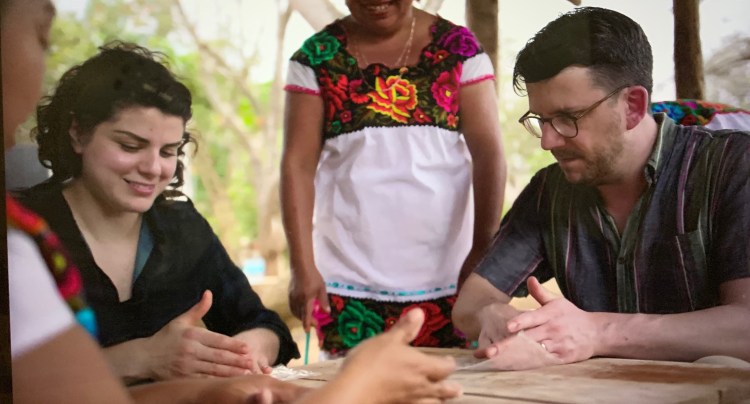
Rosio Sanchez and Pete Meehan making tortillas in Yaxunah.

“I want the people going on the trips to have a better understanding not just of the culture[…] because you can’t cook the food without understanding the people” (Arellano 102). Marylin Tausend, said it best– one cannot cook (professionally) without understanding the people. This rings true especially if someone is not a native of the country whose food the wish to specialize in. In the Netflix show, Ugly Delicious, Chefs like Rosio Sanchez who is of Mexican descent, still need to pay homage to Mexico. There is a significant amount of time that focuses on Rosio and Peter Meehan’s emersion into local Mexican cooking in Yaxunah. They had to recognize how things are done without modern appliances and appreciate the people behind the food. But, what is still unsettling is that the two women that were the main cooks in the village were asked to make tortillas at Sanchez’s high-end restaurant, Noma– which caters to tourists. So, for me, this instance blurs the line between helping and insulting Yaxhunah, because tourists are having freshly made tortillas by women of the community, yet they are still dinning in a “sanitized” environment that separates them from being with the people. Similar to the post “Appropriation, Again!,” it is important to recognize a culture food and its people but now, I would like to see more chefs invite all audiences to enjoy their food, not just the privileged ones.

References:

Arellano, Gustavo. Taco USA: How Mexican Food Conquered America. New York: Scribner, 2012. Print. 102

Chang, David, director. Ugly Delicious Netflix Official Site, 23 Feb. 2018, http://www.netflix.com/watch/80191117?trackId=14170287&tctx=0%2C0%2Cddb8d8b1-b501-4940-9981-0811a010e779-26716971%2C512b7009-7d51-44ee-85a8-08f86fdb6a31_9804926X3XX1582770688256%2C512b7009-7d51-44ee-85a8-08f86fdb6a31_ROOT.

Madness on Wheels

Barria Landia, at the corner of 78th St. and Roosevelt Avenue. © Melissa Hom

What’s on wheels, serves food, and satisfies hunger? A food truck! I think food trucks are the gateway for small restaurant owners to make their living affordably and smart. It is such a huge trend amongst millennials because it is quick and easy– you get your food and go. The first time I experienced the food truck culture was back at Governor’s Ball in 2017. It was amazing to think that trucks rolled into an empty field to feed hungry concert goers! What is even more amazing is that food trucks have become so popular, their normal location can be pinned on Google Maps (hence that it’s a truck). That brings me to Birria-Landia, a Mexican food truck in Jackson Heights that serves its community with pride.  The Tijuana-style is what sets it apart from other restaurants, serving beef seasoned with adobo, and prided red tortillas baptized in beef fat. It is a staple restaurant on Roosevelt Avenue, providing affordable food for the hard-working people that stop by on their way home. In general, the food truck culture has allowed for rising chefs to find their voice, and expand their creativity. They are able to put their own twist on food without the pressures of conforming to the standards of a restaurant– and in the end, make people happy. 

Appropriation, Again!

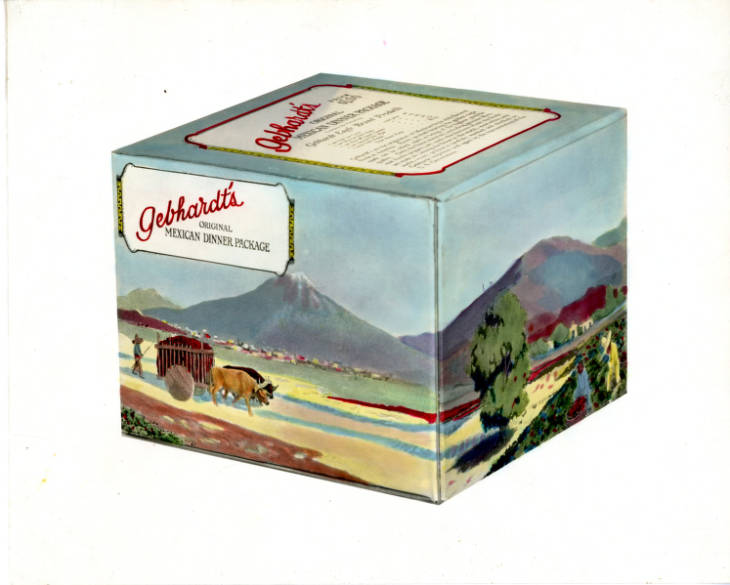
Gebhardt’s Original Mexican Dinner Package, circa 1920s.

In my first post, “Cultural Appropriation,” I mentioned Taco Bell and Chipotle as commercialized Mexican food. Even though there is nowhere on their websites that explicitly state that they offer “clean Mexican food,” it is well understood to be just that. With the changing of times, companies have learned that putting their bias out there could have ramifications. A customer can choose whether or not to eat at their restaurant because of their expressed views. Yet during the time when sensitivity was non-existent towards new immigrant groups, Gebhardt, had no problem asserting his canned goods and Mexican dinner packages were okay for consumption: “Cognizant of the stereotypes Mexican food had even then, Gebhardt assured customers that his cuisine wasn’t like the dangerous stuff Mexican sold. Ads for his tamales assured, ‘Rigid Government Inspection insures Quality and Cleanliness…’”(Arellano 180). Gebhardt was well aware of the stigmas that were attached to Mexican food, so he made sure his Mexican food product was nothing like what the Mexicans sold. Meaning that his goal was to side with his consumers in rejecting Mexican street food culture. He wanted to give the experience of Mexican food without having to come in contact with the people themselves. In addition, with the use of institutional inspection by the government, Gebhardt knew that people wouldn’t question the safety of his products. Using authority to validate a particular behavior, way of life, or food, is what puts people at peace. It also invalidates Mexican food made by Mexicans, further confirming the misconceptions and stereotypes that are regularly pinned on what they have brought to America. Gebhardt’s vision is very similar to that of Farnsworth’s Original Mexican Restaurant. In 1900 he opened an Original with the intention of making a Mexican restaurant that meets the standards and expectations of the white consumer. Even though Mexican paintings adorned the walls and the menu was in Spanish, the “dining jackets were mandatory for men, and ads advised that within their walls were ‘elegantly appointed dining rooms in which we serve our appetizing Mexican dishes” (Arellano 130). The Mexican street food culture does not make the white consumer feel important or catered to, so in light of Gebhardt, Farnworth is assuring that the Mexican food served at Original is not the same as what the Mexican elsewhere are serving. The mandated dining jackets are deeply associated with the notion of being “sterile” and a lack of interaction with non-white races. Gebhardt’s vision of “clean Mexican food” is the epitome of cultural appropriation– it is taking the recipes out of the hands of Mexicans and serving it on a porcelain plate to consumers who refuse to acknowledge its origin.

References:

Arellano, Gustavo. Taco USA: How Mexican Food Conquered America. New York: Scribner, 2012. Print. 130, 179-180

Taco Awareness

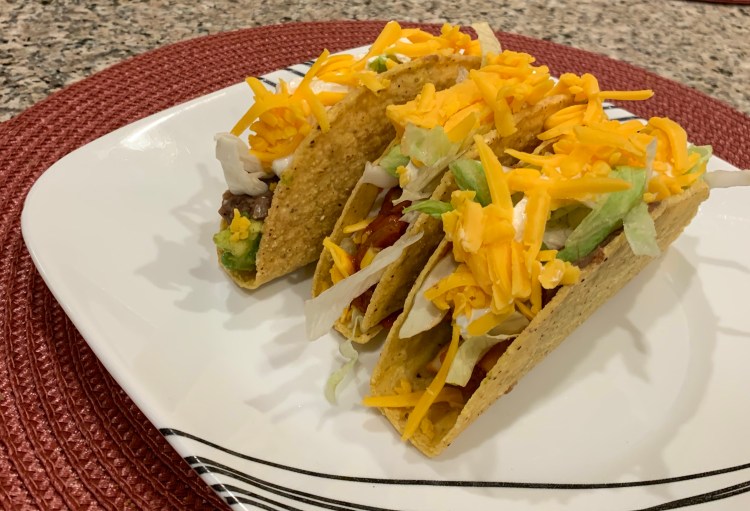
Homemade tacos with a flavorful base of seasoned ground beef and refried beans.

It’s Common Hour in the D’Angelo Center of St. John’s University. Classes have ceased for an hour and a half, and students are hungry. Amongst the eating options is no other than Taco Bell, well known fast-food Mexican chain which has ruled America for decades. The line leading up the register is long and winding. Once you get the order of tacos, your stomach rumbles more and mouth salivates in anticipation. Finally, you sit down and unwrap the thin paper to reveal the tacos, and your expectations fly out the window. This is actually what happened to me, and with the tacos before me, I was deeply saddened. The color of the shell was a faint yellow, and there was barely a line beef inside, and the lettuce was so bitter that it reminded me of black coffee. In terms of taste, it was lifeless– everything tasted generic and commercialized; there was no uniqueness, nothing setting them from more authentic tasting foods. I was disappointed, and I began to think about what people in American think is a “good tasting taco”– the line at St. John’s was long and Taco Bell has a cantina-style restaurant on 8th avenue in Manhattan. So, does this mean that people think that these tacos are really worth it? Gustavo Arellano is a proponent of real Mexican cuisine attests to what a good “taco environment” should look like through his observation at the Milta Café in Southern California: “When a customer asks for a hard-shelled taco with ground beef, the order is repeated in Spanish– taco dorado con carne molida. A cook grabs a corn tortilla, places it in a canister, and fries it. No prefabricated mess here– it the real deal, the opposite of what Bell envisioned… The Taco Bell is dead. Long live the taco” (Arellano 70). This experience does not exist at Taco Bell. The same way you should avoid a restaurant that uses tortillas from a prepackaged bag is the same way you should avoid a restaurant that has prepackaged taco shells. The experience that Gustavo is describing is one that encompasses what more and more Americans want in a Mexican restaurant– a feeling like home. Across all cultures, everyone has a vision of a parent or adult making food from scratch before their eyes. Therefore, when a cook is seen taking tortillas out of a bag it gives the impression that the consumer can do the job themselves– which defeats the purpose of a restaurant. Besides, Taco Bell has distanced themselves by getting rid of the Spanish names for the items its menu. The lack of Spanish based names represents that will never an authentic Mexican restaurant that works to immerse the customer into the culture. So, to me Taco Bell is dead, has been so Americanized and appropriated that its flavors cannot be connected to what a taco is supposed to be. So, the next time you want to visit a Taco Bell, remember, your taste buds deserve better!

References:

Arellano, Gustavo. Taco USA: How Mexican Food Conquered America. New York: Scribner, 2012. Print. 70

New Ingredients

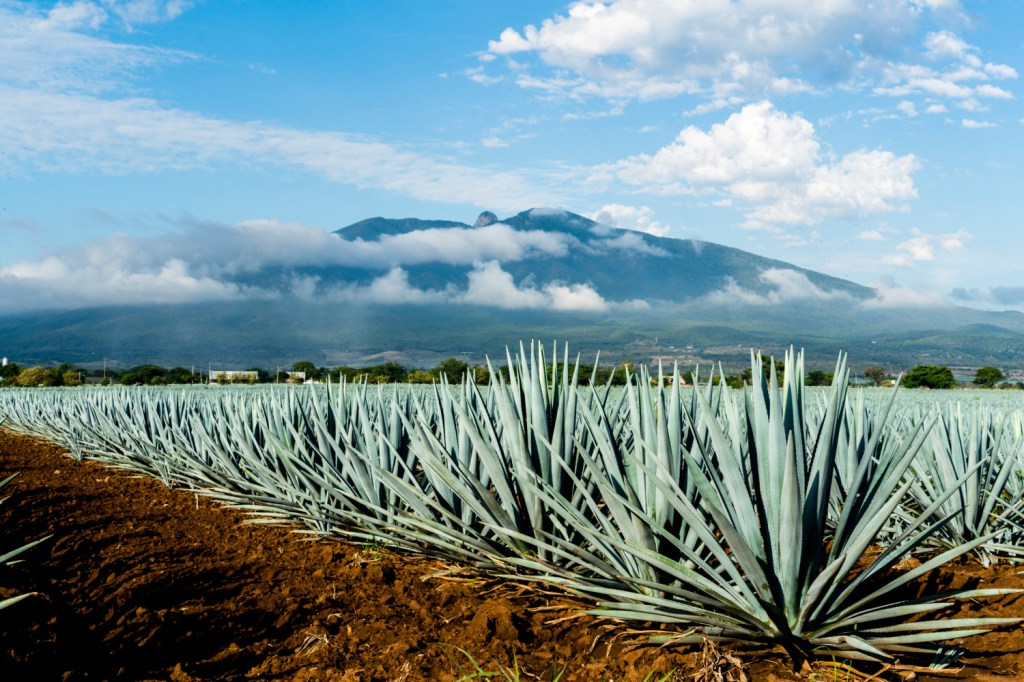
The Spanish Inquisition changed the future livelihood of the Aztecs forever. Imagine being fully dependent on vegetation since the beginning of time. All you have known is that the gods grant good growing seasons, and your job is to constantly tend to the land. Once the Spanish colonists arrived, they introduced livestock like chicken, beef, and pork. The Aztec diet transitioned from “vegan” to carnivorous leading to what will eventually become one of the most sought-after cuisines in the world. Also, the Spanish came the method of distillation of the agave/maguey plant, which led to the creation of what is now tequila. According to Gustavo Arellano’s Taco USA, the introduction of these new ingredients was a direct result of Moctezuma’s compliance to provide the conquistadors with their native food. That action led to outsiders’ constant need to appropriate the Aztec’s original food to their own liking. This can also be known as taking advantage of a group of people who did not know any better– and instead of sticking to their traditions.

Citation:

Arellano, Gustavo. Taco USA: How Mexican Food Conquered America. New York: Scribner, 2012. Print. 17

Mexican-(insert different country here) Food

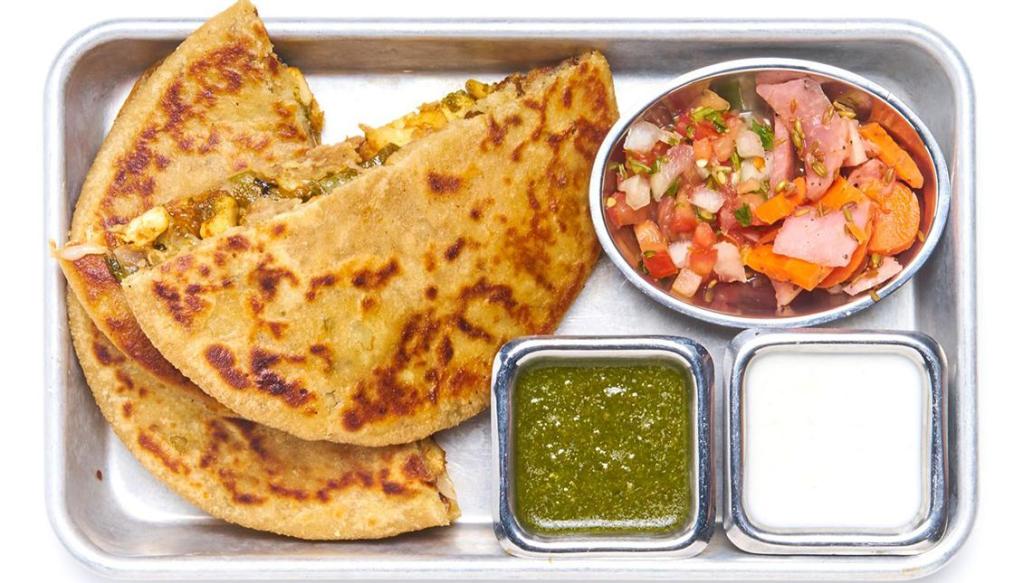
Roti quesadillas, Naan and tortillas… wait, is this Mexican food or Indian food? Well during the late 1800’s and early 1900s Punjabi men immigrated to the United States for work. By 1917 there was an immigration Act that prevented mostly Asians from coming into the country. Therefore, it left Punjabi men in places like Yuba City to mesh with Mexican women, since minorities were barred from marrying whites. Naturally, as the more dual-cultured couple emerged, the food did the same. The women in these marriages were tasked with the mission to preserve the food of her husband while also maintaining their food customs. As a result, foods like curry chicken enchiladas emerged, and a new type of restaurant was in town. El Ranchero was one of the first Punjabi-Mexican restaurants to open and had functioned as just one of many dual-cultures restaurants that served the community.

Citation:


Chopra, Sonia. “California’s Lost (and Found) Punjabi-Mexican Cuisine.” Eater, Eater, 23 Apr. 2019, http://www.eater.com/2019/4/23/18305011/punjabi-mexican-migration-roti-quesadilla-el-ranchero.

García, Beatriz. “The Mexican Punjabis in California Who Turned Quesadillas into a Symbol of Identity.” AL DÍA News, 6 Jan. 2020, aldianews.com/articles/culture/social/mexican-punjabis-california-who-turned-quesadillas-symbol-identity/57241.

Design a site like this with WordPress.com
Get started