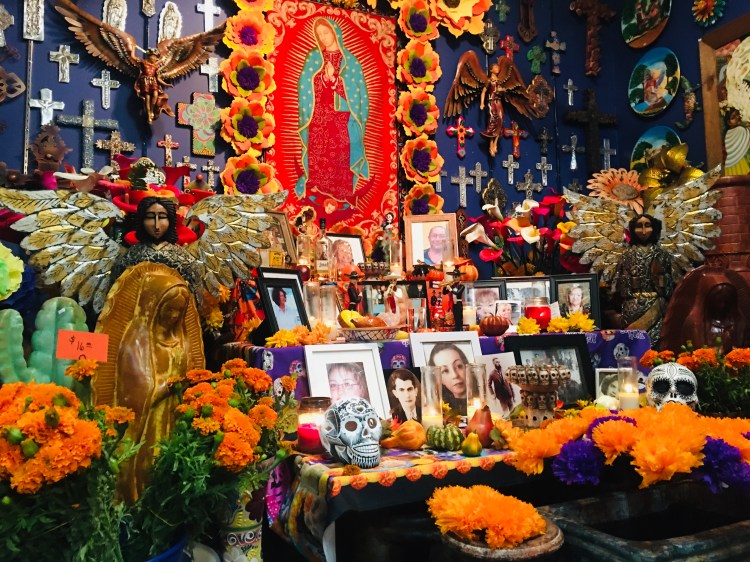
When I saw Disney Pixar’s Coco for the first time, I was finally able to pin the name ofrenda, the flower-covered shine that I have seen on TV shows and children’s cartoons for years. More so I was able to understand a little bit more about what the ofrenda means in Mexican culture. According to Catalina Delgado-Trunk, “an ofrenda is a shrine or altar space that acts as a memorial or tribute to one who has died” (312). The ofrenda is especially important in celebrating El Día de Los Muertos, or the Day of the Dead. What strikes me most about Día de Los Muertos, is that it is one of the ancient Mexican traditions that could not be erased by the coming of Spanish settlers. Also, this celebration so fascinating because it has been integrated with the practice of Catholicism– and many countries tend not to celebrate “All Souls Day” in the same way. Usually, it is celebrated with a prayer service in the church. But in Mexico, is the ofrenda is at the center of this celebration because is it how families honor the members who passed by welcoming them back to their home. On the ofrenda is usually a picture of the person who passed, depending on the region papel picados, various flowers, and of course food. “Traditionally, the ofrenda is placed on a table that serves a double purpose. It is an altar space for prayer, as well as a place to display food that has been prepared for the soul invited to dinner. The food is placed in new clay pots and baskets which are arranged on a petate (mat) or on a well-starched linen clot.” I think it is safe to stay that even in death, food is a way to keep a family connected. What I love so much about this custom is that placing food on the ofrenda is a symbol that the family wants the returning spirits to feel right at home. I could only imagine that if someone who has passed on loves mole with turkey would (in their spiritual form) be appreciative of that dish being presented in their memory. Also, the manner in which the food is arranged on the ofrenda is admirable because even the food must be on something that is new. It places emphasis on the importance of the life that they lived, and show the spirits that they will continue to be loved. Lastly, besides mole and tamales, pan de muerto, the bread of the dead, is placed on the ofrenda. This bread is similar to pan dulce, and is made with flour, eggs, and orange zest– once it is baked it can be covered with sugar or sprinkles. On the bread itself, symbols like bones, crescent moons, and silhouettes of animals can be found. The significance of the pan de muerto is that the serves as a source of “essence” for the nourishment of the visiting spirit. When it comes to beautiful traditions like the ones practiced on Dia de Los Muertos, it allows the family, both living and dead, to maintain an everlasting connection so that no one is forgotten.
Work Citied:
Congdon, Kristin G., et al. “Teaching about the ‘Ofrenda’ and Experiences on the Border.” Studies in Art Education, vol. 40, no. 4, 1999, pp. 312–317., doi:10.2307/1320552.
Martínez, Mely. “Mexican Bread of the Dead Recipe: Receta Pan De Muerto.” Mexico In My Kitchen, 12 Aug. 2019, http://www.mexicoinmykitchen.com/pan-de-muerto-mexican-bread-of-dead/.
 Authentic Taqueria Only