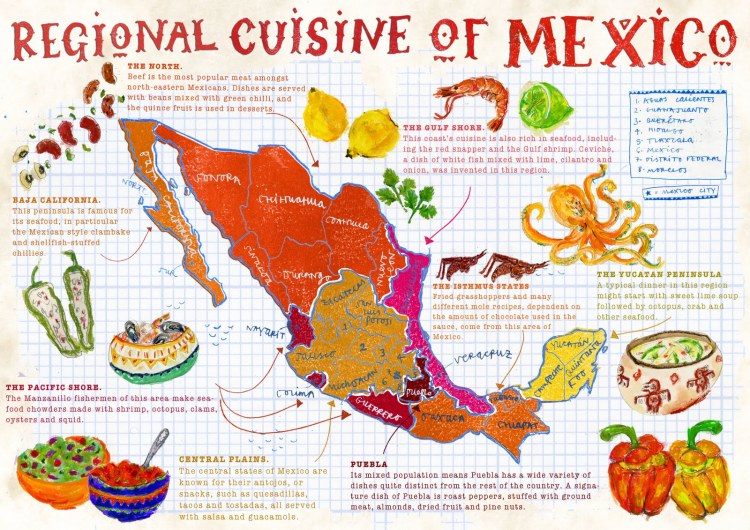
Ever since I was 14 (the age I believe my taste buds matured), I have insisted that on my birthday we dine at a Mexican restaurant. The first notable restaurant I remember visiting was El Mariachi, in Rockville Center. The inside was adobe style, with curved thresholds; walls decorated with Mayan calendars and serape blankets. The food was amazing and that is where I fell in love with enchiladas. The second restaurant in the city is El Cantanero, located in the West Village. This restaurant was similar to El Mariachi, but this time, it has two levels, with the second being a full-fledged club. I can say with confidence that El Cantanero has some of the best chimichangas I’ve ever. I know this sounds like a restaurant review, but it’s not– this is an acknowledgment of two Mexican restaurants out of thousands that have established themselves in New York City and Long Island. And thinking deeply about how Mexican foodways, I now realize how much people enjoy it. But we wouldn’t be able to experience Mexican food if people didn’t immigrate and set up restaurants that share the food with a new country and community. In Jeffery M. Picher’s Planet Taco, he mentions the success of Mexican chefs, “[y]et, even with a growing Mexican national homogenization, chefs remain proud of their hometowns and will gladly explain their local culinary twists. Indigenous population offers the most distinctive cuisines…” (208). The restaurants described above are the product of immigrants whose mission is to share not only the generic cuisines of Mexico but also the cuisines of the indigenous states of Mexico. The idea of explaining the specifics of a dish with a customer at a restaurant is how the people of the new country (the United States) learn about what makes Mexican food special. For example, a customer asks about the “green sauce” on a tostada, and the waiter replies the main ingredient are poblano peppers. That leads the customer not only to wonder what poblano peppers are but also allows them to realize that the taste associated with the green sauce can only be attributed to the poblano pepper because it is truly unique. I think having a Mexican restaurant in the United States, especially New York City, chefs forced to put their twists on dishes because the standard ingredients are not available. And these twists are just as prevalent as eating the “real thing” in Mexico because it continues to attract people new to Mexican food but also those who crave to feel closer to home. The presence of fellow Mexicans in a restaurant is what signifies the owners and the people that work there that what they do means something. Maybe that time when I celebrated my birthday at El Cantanero, somewhere else in the restaurant someone was celebrating finding a restaurant that made food closest the way they know it to taste. Further, having the presence of various indigenous foods creates a multiverse of ways to experience Mexico two thousand miles away.
Works Cited:
Pilcher, Jeffrey M. Planet Taco: a Global History of Mexican Food. Oxford University Press, 2017.
 Authentic Taqueria Only