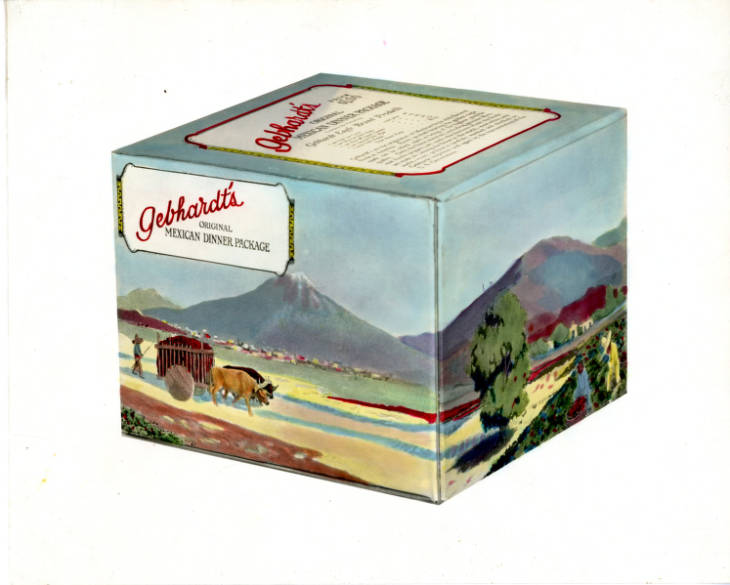
In my first post, “Cultural Appropriation,” I mentioned Taco Bell and Chipotle as commercialized Mexican food. Even though there is nowhere on their websites that explicitly state that they offer “clean Mexican food,” it is well understood to be just that. With the changing of times, companies have learned that putting their bias out there could have ramifications. A customer can choose whether or not to eat at their restaurant because of their expressed views. Yet during the time when sensitivity was non-existent towards new immigrant groups, Gebhardt, had no problem asserting his canned goods and Mexican dinner packages were okay for consumption: “Cognizant of the stereotypes Mexican food had even then, Gebhardt assured customers that his cuisine wasn’t like the dangerous stuff Mexican sold. Ads for his tamales assured, ‘Rigid Government Inspection insures Quality and Cleanliness…’”(Arellano 180). Gebhardt was well aware of the stigmas that were attached to Mexican food, so he made sure his Mexican food product was nothing like what the Mexicans sold. Meaning that his goal was to side with his consumers in rejecting Mexican street food culture. He wanted to give the experience of Mexican food without having to come in contact with the people themselves. In addition, with the use of institutional inspection by the government, Gebhardt knew that people wouldn’t question the safety of his products. Using authority to validate a particular behavior, way of life, or food, is what puts people at peace. It also invalidates Mexican food made by Mexicans, further confirming the misconceptions and stereotypes that are regularly pinned on what they have brought to America. Gebhardt’s vision is very similar to that of Farnsworth’s Original Mexican Restaurant. In 1900 he opened an Original with the intention of making a Mexican restaurant that meets the standards and expectations of the white consumer. Even though Mexican paintings adorned the walls and the menu was in Spanish, the “dining jackets were mandatory for men, and ads advised that within their walls were ‘elegantly appointed dining rooms in which we serve our appetizing Mexican dishes” (Arellano 130). The Mexican street food culture does not make the white consumer feel important or catered to, so in light of Gebhardt, Farnworth is assuring that the Mexican food served at Original is not the same as what the Mexican elsewhere are serving. The mandated dining jackets are deeply associated with the notion of being “sterile” and a lack of interaction with non-white races. Gebhardt’s vision of “clean Mexican food” is the epitome of cultural appropriation– it is taking the recipes out of the hands of Mexicans and serving it on a porcelain plate to consumers who refuse to acknowledge its origin.
References:
Arellano, Gustavo. Taco USA: How Mexican Food Conquered America. New York: Scribner, 2012. Print. 130, 179-180
 Authentic Taqueria Only